



Anchors for longlining usually weigh between 25 and 65 pounds. They come with four or five flukes and a ring on top. The weight needed depends on the current and the depth where you’re setting your gear.
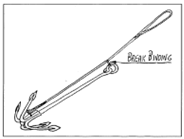
Working on hard bottom, an anchor can get stuck, and the line might break before it comes loose. This can be avoided by fastening the anchor lanyard to the bottom of the anchor (MAKE SENSE??), with only loosely attached to the top ring. If the anchor jams, the twine will snap under strain, and you’ll be able to haul the anchor up bottom-first without losing it.
For the anchor lanyard, a ½-inch (12 mm) polypropylene monofibre rope works well, or any rope with greater tensile strength than your buoy line. When rigged, the anchor line should extend three to four feet beyond the anchor ring. If the anchor also has a bottom ring, it is useful to make the anchor lanyard with a loop at each end (about 22 inches long). One loop goes around the bottom ring, and the other ties into the buoy line and the slingshot.
The number of anchors you need depends on how you intend to fish. If you plan fishing with short strings, you will need two anchors for each string, and you may have 3-6 strings out at any one time. If you intend fishing with a single continuous string you may need 10-12 anchors. A good rule is to keep 8-15 anchors aboard, including spares.
The twine attaching the anchor lanyard to the top ring should break when the load is about half of what the groundline can tolerate. A single strand taken from a new groundline is about the right strength for this purpose.
he slingshot is a piece of line used to connect the anchor lanyard on the foredeck to the groundline on the aft deck. You make it by splicing a 2’ eye at each end of a polyester buoy line. The length should be just enough to reach from the anchor, hanging ready on the gunwale, run along the outside of the boat, and then extend a few fathoms in through the shooting hatch to tie onto the end of the groundline. One slingshot is needed for every anchor on board.