



The lower part of the buoy line, the section closest to the anchor, should ideally be made from 25 fathoms (METERS??) of thick floating line. This helps prevent the buoy line from getting tangled with the anchor and also keeps the rest of the line off the seabed, reducing wear from abrasion. A polypropylene staple fibre line works well for this purpose, and its diameter should be about 0.080″ (2 mm) larger than that of the groundline. Splice a 28-inch eye at each end. You will need one of these for every anchor you carry on board.
Floats support the buoy line, with two floats needed in areas of strong current. If there is a risk that floats may be pulled under, a single 60″ inflatable float can be replaced by a string of 12-14 solid 8″ net floats of the type commonly used on drag nets. Inflatable floats may collapse if dragged deep by the current and sometimes fail to resurface, whereas net floats remain intact. Net floats also provide a simple way of gauging the strain on the buoy line: just count how many of them stay visible on the surface.
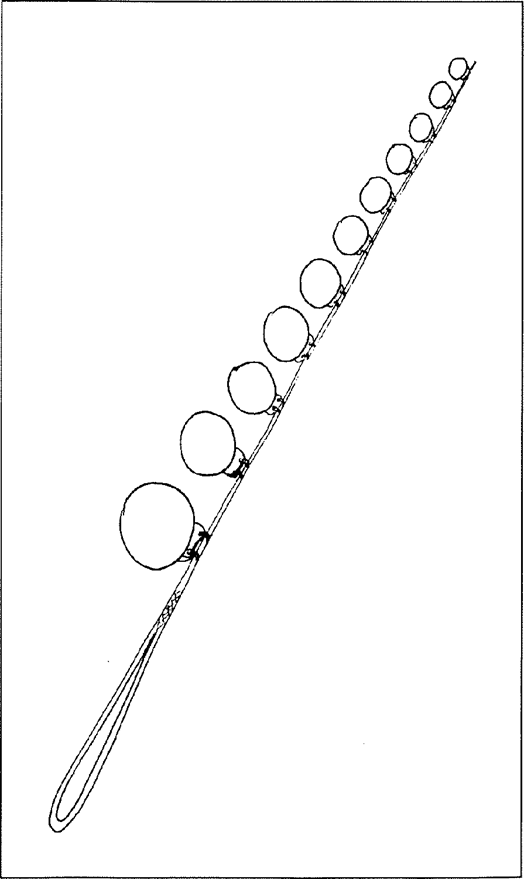
Net floeats
Your choice of floats depends on both the current and your own preference. Whichever type you use, remember that floats must be marked with the vessel’s registration number to comply with international regulations.
Floats are fitted with a float lanyard, with either a whipped end or a spliced eye, depending on how you plan to store them. A short eye is practical if the floats are kept in bins, while a whipped end works better if you plan to tie them to a rail. The lanyard should be about 4′ long, made from ½-inch 0.5″ (12 mm) floating line, such as staple fibre polypropylene. Pass the line twice through the hole in the float, splice the top end, and whip the bottom end with twine.
If you prefer an eye, make it about 2′ long using 0,4″ staple fibre polypropylene floating line. Splice the ends together and tuck the splice inside the float’s hole to protect it from abrasion. Then secure the eye with whipping twine just below the hole.
For size, choose 60 or 75″ inflatable floats, ideally in a few different colors. Avoid using floats larger than necessary – a 75″ float supports twice the load of a 60″ one, but it also takes up twice the storage space. Using different colors also makes it easier to keep track of your progress while hauling. In general, you will need about twice as many floats as you have anchors.
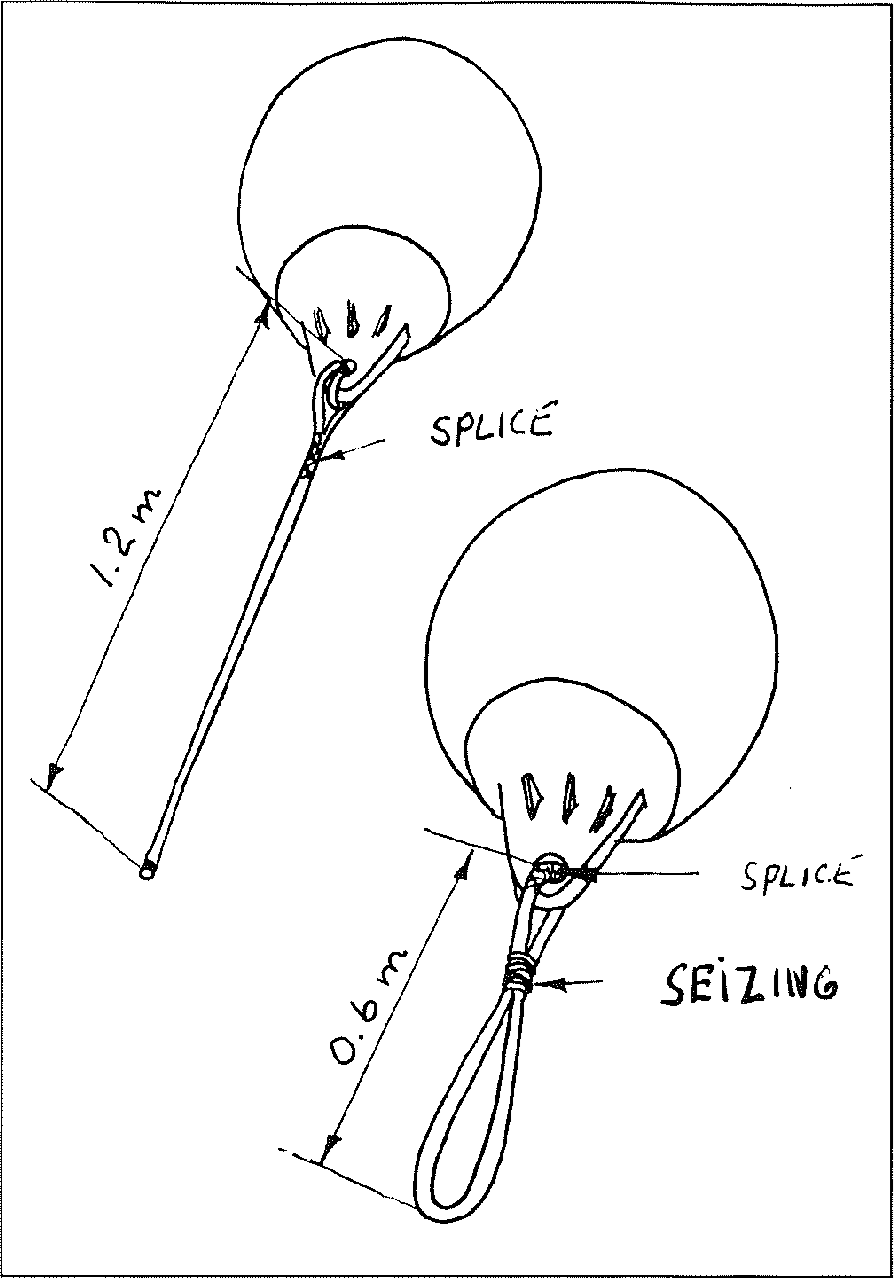
Rigging inflatable floats