



Cut off snoods that are either damaged or have irreparable hooks. You will also need to tie in new snoods. (Detailed instructions for this process can be found in the chapter on snoods).
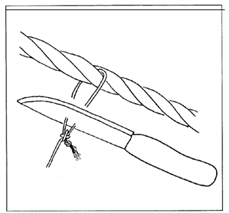
Cut the snood between the knot and the line: Cut right through the loop, leaving two ends (Figure 10). This makes it easy to know where to insert the new snood. Avoid letting your work pile up in front of you. If the workload increases, pass some tasks to the next person in line.
Ensure there is ample space on the storage rail between you and the hook separator. Being too focused on cutting off snoods can cause you to forget to slide on the loops, leading to congestion near the hook separator, which hampers their work and increases the overall workload further down the line.
If a fish has been on a hook, its snood often becomes twisted around the line. To straighten this out, use a large swivel fixed to the edge of the shelf in front of you. Hook the fishhook into the swivel and pull the snood until most of the twists are removed.
The number of people required along the storage rails depends on the type of fish being caught. Typically, one person is needed for this task. This person also bends hooks back into shape, removes hooks with bad points, splices line from sorted tangles, and helps move the storage rails.